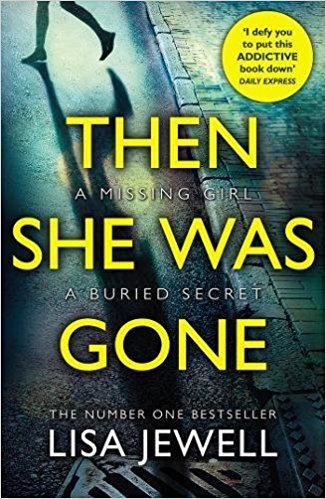
Book Review: Then She Was Gone by Lisa Jewell

then she was gone

It’s been a while since I’ve read a book that I couldn’t put down and I admit I’m quite late to the party when it comes to Lisa Jewell novels. I downloaded Then She Was Gone to my Kindle on a Wednesday evening and, by the weekend, had finished it. No mean feat considering that, in between reading sessions, I had a birthday, mother’s day, a trip away with my boys and some shifts at my day job.

Then She Was Gone tells the story of 55-year-old Laurel Mack whose daughter Ellie disappeared when she was fifteen. Laurel has spent the ten years since the tragedy trying to rebuild her life. She has separated from her husband Paul and has an uneasy relationship with her remaining children Hanna and Jack. While the rest of her family seem to have moved on with their lives, Laurel has never given up hope of finding her daughter, struggling to maintain relationships and live in the present. When Laurel meets handsome American Floyd in a café, she finally begins to see a way forward, the joy of being in a new relationship lifting her spirits. However, when she meets Floyd’s unusual and older-than-her-age daughter Poppy, Laurel once again finds herself in the grip of past hurts. Who is this strange child and where did she come from? Can she and her father somehow lead Laurel to find out what happened to Ellie all those years ago?

Marketed as a psychological suspense novel, Then She Was Gone is more a disturbing character study that focusses on the impact of trauma and the domino effect one person’s actions can have on all involved. Flitting between the past and the present, as well as various points of view, Jewell begins to tell us the story in flashback, each revelation then taking us forward to Laurel in the present and successfully moving the story on. Admittedly, as a few other reviewers have pointed out, some of the plot of this novel requires a slight suspension of disbelief and, for me, the ending of the book kind of fizzles out a little, the showdown that I might have expected from a psychological suspense never quite arriving.

However, Jewell’s characters are believable and sympathetic and Then She Was Gone is a touching study of loss and hope. Definitely a page-turner.

Review: Ellipsis Zine: Two

EZTwo

Read three over a cup of coffee. Read four on your daily commute. Read one that will make you think twice.

I was recently given the opportunity to read Issue Two of Ellipsis Zine in return for an honest review. Ellipsis Zine, launched by Steve Campbell in 2017, is an online and print literary magazine that publishes flash fiction and short creative non-fiction with each contribution within the 1000-word mark. As stated on the Ellipsis website: We love stories that make us forget where we are, stories that introduce us to people, places and things we’ve never seen before and stories that stick with us long after we leave them.

Ellipsis Zine: Two is a stunning collection of flash that explores themes such as loss, escape, infidelity and the impact of trauma.

In Jack Somers’ Billy, a wounded child feels the presence of his father’s past. As Dad tends to the boy’s injured foot, his son gains a mature insight into how past hurt can linger.

In the marvellously succinct opening of First Untruths, Tomas Marcantonio’s incredible use of description drags the reader back to the churches of childhood in a just a few well-chosen words: The thurible swung from its gibbet chains, releasing a heavy cloud of hallucinations to the rafters, and the purple tang of incense tickled in my nose and throat like a mouthful of fizzy petals… The story goes on to explore the familiar childhood fear of having nothing to say in the confessional.

In the brilliantly original The Oversharing Omniscient Narrator by Caleb Echterling, character Dave tries to control his own story: He flings an empty vodka bottle at the ceiling. “Dammit! Don’t tell them that…it’s extraneous to the plot.”

In Judy Darley’s fabulously insightful Flamingos and Ham, personalities and gender practically become non-existent as colours are outlawed: “Don’t let them make you believe that this is normal. You wore pink once…”

In Lucie McKnight Hardy’s highly moving Diptych, a hot and bickering family take a long journey to the funeral of loved-one, McKnight Hardy’s wonderful use of description again lingering in the reader’s mind long after the short is finished: Bewilderment filters through, intensified by silence; a diptych carved from grief.

And, in the not-too-distant future of Luke Richardson’s Two Minutes, Richardson’s protagonist marvels at past levels of concentration: before computers and machines completed complicated tasks, people had to concentrate for as long as an hour. You’d seen pictures of them driving cars and trains, operating machines, reading books.

A brilliant flash fiction showcase that is ideal for those random moments when you need nothing more than a quick literary fix, Ellipsis Zine publishes new work online every Monday, Wednesday and Friday and even offers writers a share of the royalties, as well as a complimentary copy of the print edition. All submitting authors also receive purchase discounts.

For information about submitting and to purchase Issues One and Two, visit the Ellipsis Zine website.